When Basma AlSulaiman first set foot in AlUla back in 2017, she had already been voted as one of the art world’s 100 most influential people. A London-based collector, she was on a group trip organised by Washington’s Smithsonian Institution to explore Hegra, one of the great archaeological sites of the world.
Despite being a Saudi ‒ born and raised in Jeddah, about 700km to the south ‒ this was her first sight of AlUla. She was, and remains, “flabbergasted” by its beauty. “I’ve been back maybe 10 times and you never lose that wow factor,” she says. “It’s like a living museum, a natural sculpture park. For me, it is nature in all its glory.”
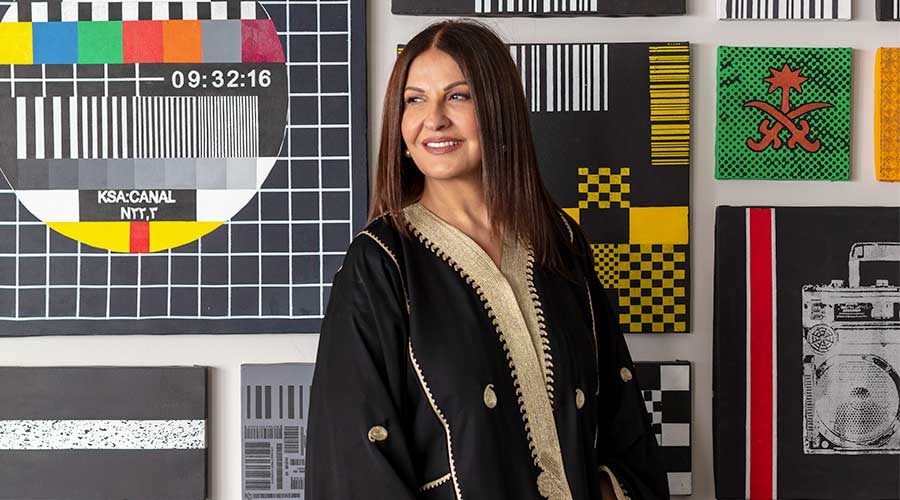
Basma AlSulaiman is the world’s foremost collector of contemporary Saudi Arabian art
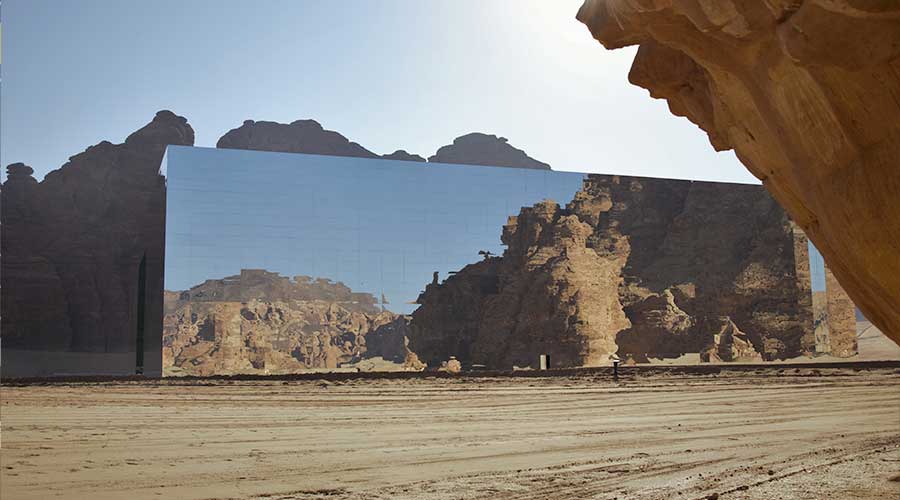
A selection of her works have been on show at the beautiful mirrored Maraya building this year
Basma AlSulaiman photo by Mark Luscombe-Whyte and Maraya, AlUla, the world’s largest mirrored building. Courtesy the Royal Commission for AlUla
When we spoke five years on from her first visit, AlSulaiman had again just returned from AlUla. This time she wasn’t there for the views but to see some of her most precious works of Saudi art on display at the What Lies Within exhibition, which Architectural Digest has called “simply unmissable”.
“I guess you could say it’s my moment,” AlSulaiman laughs. “It feels good that after 20 years of working with the artists in Saudi, to finally be able to share that with a bigger community.”
Over the past five years, a lot has changed in Saudi Arabia. The country has officially opened up to tourism. Its people ‒ particularly its women ‒ have new freedoms. And AlUla is now firmly on the map as an arts and culture destination for an international audience.
Basma AlSulaiman, art collector
Not only that, interest in Saudi art is enjoying a huge upsurge, with auction houses staging international sales and collectors adding Jeddah and Riyadh to their itineraries. The past six months have seen both the debut of the Diriyah Biennale in Riyadh, and the opening of the Hayy Jameel's new centre in Jeddah. The Art Newspaper has talked about a “decisive shift” in the cultural landscape here, while ArtNet described it as a “paradigm-shifting moment” for the nation.
was born in Mecca, the centre of Islamic pilgrimage, a subject she approached with her groundbreaking work, The Black Arch , as the first Saudi artist to show at the Venice Biennale in 2011. Now based in Paris, she is considered to be one of Saudi’s most important artists; her work has been shown all over the world.
shadiaalem.com
The Black Arch, installation view from What Lies Within
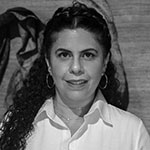
Manal uses photography, installation and sculpture to examine and critique women's roles in Saudi society. Her Drive-By Shootings collection (2011) demonstrated the difficulty female artists had to work when they couldn’t drive. She now lives in London, where she’s working on her Masters in Contemporary Art Practice in the Public Sphere at the Royal College of Art.
manalaldowayan.com
The Choice, 2005. Photo by MAD Studio. Courtesy of the artist and Basma AlSulaiman
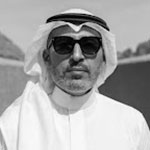
His works revolve around reimagining found objects, to create narratives informed by Islam and Saudi history and identity. A member of the Saudi royal family, he also acts as an adviser to the Saudi Ministry of Culture, and promotes young Saudi artists and designers to the rest of the world. His work, Desert Kite, at Desert X AlUla 2022 addresses the mysteries and mysticism of the desert.
athrart.com
Desert Kite 2022, installation view courtesy Desert X AlUla and Lance Gerber
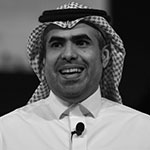
A medical doctor and artist, Mater is known for his artworks using X-rays, as well as those that comment on the rapid globalisation of Saudi Arabia. He was one of the three founding artists involved in the Edge of Arabia project, which aimed to bring the work of Saudi artists to a wider audience, and has also had solo shows in London and Dubai.
ahmedmater.com
Magnetism, 2009. Photo by Christie’s Images Ltd. Reproduced courtesy the artist and Basma AlSulaiman
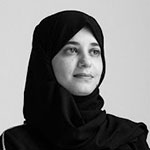
Is best known for her large-scale installations, like Glimpses of the Past, a river made from around 6,000 date tins for Desert X AlUla 2020. She’s also a professor in the Islamic Arts Department at King Abdulaziz University and was chosen to inaugurate Saudi Arabia’s pavilion at the 2019 edition of the Venice Biennale.
instagram.com/dr.zahrah_alghamdi
Glimpses of the Past 2020, installation view courtesy Desert X AlUla and Lance Gerber
A self taught sculptor, interdisciplinary conceptual artist and writer based in Riyadh, Saudi Arabia. Her photo series, Tales of Sisterhood in Hospitality 2021, explores the human condition of working class women in pre-internet Riyadh, specifically subabas (coffee caterers). It was shown as part of Jeddah Photo 22, held this year for the first time.
elhamdawsari.com
Tales of Sisterhood in Hospitality, 2021
Born in 1959 in Riyadh, Maha has witnessed much of the rapid change that has affected her country since the discovery of oil. Much of her work centres around found objects, like Food for Thought, a display of pans that is a reflection on the impact of globalisation on everyday life and culture.
instagram.com/mahamalluh
That the country, with its lingering reputation as a dour, ascetic land, even has a thriving art market may come as a surprise to many. But AlSulaiman, who has spent two decades of buying up contemporary Saudi works she says no-one else wanted, feels vindicated. “For me it’s all about sharing and supporting the Saudi art scene, so it’s just a perfect moment.”
To understand what has changed here we must go back a couple of generations. The discovery of oil here in 1938 – just six years after independence – wrenched Saudi Arabia into the modern world. Saudis travelled for work, play and education. They acquired Western qualifications and tastes.
While art in the Kingdom had traditionally centred on “more the craft form of art”, with calligraphy and the formal geometry of Islamic decoration, from the 1950s a wider range of artistic styles were explored. Some Saudi artists were sent overseas to European cities to learn about Modern styles.
But just as a viable arts scene was beginning to be established, the conservative backlash of the 1980s and 1990s took hold. Cinema was banned, the arts sternly discouraged. Many wealthy Saudis, nomadic by tradition, travelled the world and found new bases and new ways of pursuing their passions.
AlSulaiman, who was born and educated in Jeddah, found herself in London’s art world. Her collection began in 1992 with the acquisition of a work by David Hockney and she began to develop a reputation as a collector of Western and Chinese art.
Basma AlSulaiman, art collector
It was only after she witnessed the epochal Saatchi exhibition ‘Sensation’ at The Royal Academy in 1997, and after completing a diploma in modern and contemporary art at Christie’s in 2000, that she decided to build a collection that focused on her homeland.
By the 1990s a new wave of art was being made in the Kingdom, which was influenced by conceptual art practices but very much rooted in a particularly Saudi identity. “In line with our customs, heritage, religion and spirituality,” explains AlSulaiman. It was conceptual, experimental and exciting but was completely unsung either at home or abroad. “Nobody understood it.”
Nobody, that is, except AlSulaiman who, thanks to her education and position, saw the new wave of art being made by her compatriots “from a different angle”.
“I felt I had a responsibility to preserve this moment,” she says. “Being privileged and exposed to Western art, and being able to travel following the path of art fairs, I thought why [shouldn’t] I be a patron?”
Together with a small group of Western artists and gallerists, she began to raise awareness of the movement. In 2008, under the name Edge of Arabia, they began to organise exhibitions, beginning with one at The Brunei Gallery at SOAS in London, which brought together 17 contemporary male and female Saudi artists.
“It was well received,” she says, but in general, “the movement was not popular. There was no market.” She became the market, buying up everything of import coming out of the country. With some artists this wasn’t just the odd piece but works from every year of their career.
Artist Manal Al Dowayan on how Basma AlSulaiman’s passion has supported a generation of Saudi artists
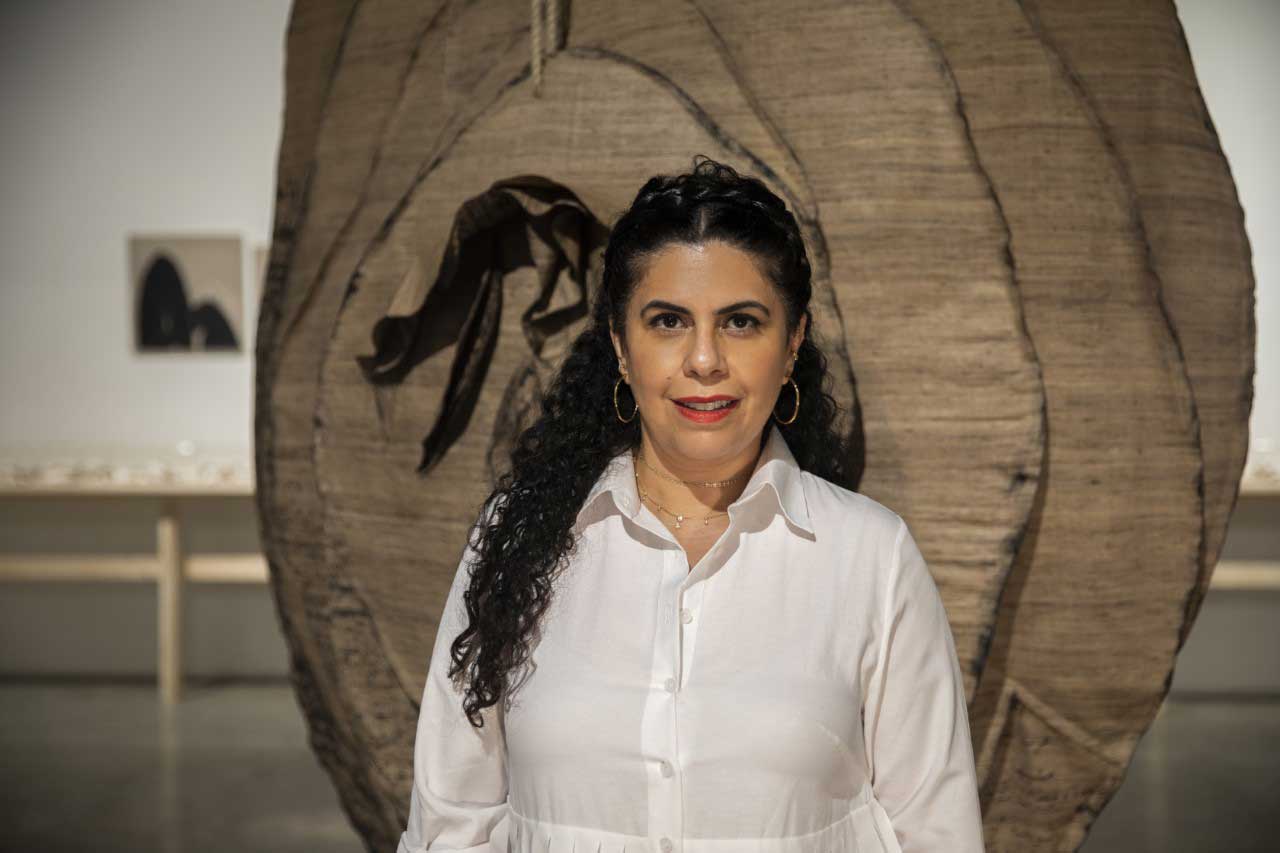
Once she had a significant collection, the next step was to share it with the world but “it was difficult logistically to do it in Saudi”.
Undeterred, she began researching VR technology and commissioned her own public museum ‒ in cyberspace. Launched in 2010 her virtual “island museum in the middle of the Red Sea” is named Basmoca (for Basma AlSulaiman’s Museum of Contemporary Art). It can still be downloaded and virtually walked through on any device today.
“I did the metaverse before everyone else,” she laughs.
By the time Basmoca was up and running, the “biggest exposure of Saudi art” to date was well on its way, too. In 2011 The Black Arch, by Saudi artist Shadia Alem, was shown at the Venice Biennale. An extraordinary installation created in stainless steel, cast iron, fabric and stone that reflects the experience of the hajj, the annual pilgrimage to Mecca, its appearance in Venice was a hugely significant moment.
But after the show it remained unsold for a year and was on the point of going to the American embassy. AlSulaiman was inspired by art-saving movements she had seen in the UK, like that of the Goya portrait of the Duke of Wellington, which was saved for the nation. “And so I bought [The Black Arch]... and I kept it in storage for 11 years.”
She now buys up many major work that might be lost to Saudi Arabia, and visitors to What Lies Within are the beneficiaries of this policy. The Black Arch is one of its star exhibits ‒ fitting, considering that Alem’s work shows a deep and ancient connection to Arabic astronomy, geometry and the cosmos.
Also featured is Ahmed Mater’s 2009 Magnetism installation, which shows iron filings radiating from a black, cube-like pilgrims thronging the Kaaba in Mecca ‒ bought from Christie’s in 2020 for £100,000.
Not every piece in the show is centred on grand religious themes though. Take the work of Maha Malluh, who seeks out pots and pans from flea markets for an unusual representation of everyday life. “These utensils are what have always been used to create a meal, but also the stories around it,” says AlSulaiman.
As Saudi Arabia has opened up and the infrastructure for a domestic art scene is slowly being built, AlSulaiman has played a major role here to. In 2013 she helped restore the Jeddah Sculpture Park, where works by Henry Moore, Joan Miro and Alexander Calder are displayed on the corniche of that seaside city.
That same year she became a founder member of the Saudi Art Council, which in turn organises the non-profit initiative 21,39, an umbrella event for exhibitions, gallery openings, workshops and a series of talks and discussions. She even opens up her Jeddah home as a public gallery. A year later she became the first Saudi woman to be honoured by the Kingdom for her contribution to the arts.
Just one significant thing was missing: a physical outlet for her collection. On that first trip to AlUla in 2017, she was able to pull strings in that direction, too, talking to Amr AlMadani, chief executive of the newly-founded Royal Commission for AlUla. The idea for What Lies Within began to take shape.
Basma AlSulaiman, art collector
This 2022 exhibition featured some of the most significant artworks from the Saudi Arabia, from 17 artists collected over a period of 20 years. Like the Saatchi exhibition that inspired her in 1997, it has been a real ‘sensation’.
For AlSulaiman, her patronage goes beyond just wanting to share art ‒ it’s about representation of a culture that has a one-note and often negative connotation in the wider world.
“I’m a very proud Saudi and I feel I have the responsibility to do this,” she says. “I have the privilege so it’s important to be a part of my society and to give back.”
Art has the power to change minds - and she hopes that by seeing works that represent national identity from the authentic voices of its artists, people will stop seeing her country in a certain way.
“If I look around me now, the changes are remarkable. I feel that we need to be given a chance.”
For more information on visiting AlUla or to book a trip, visit experiencealula.com
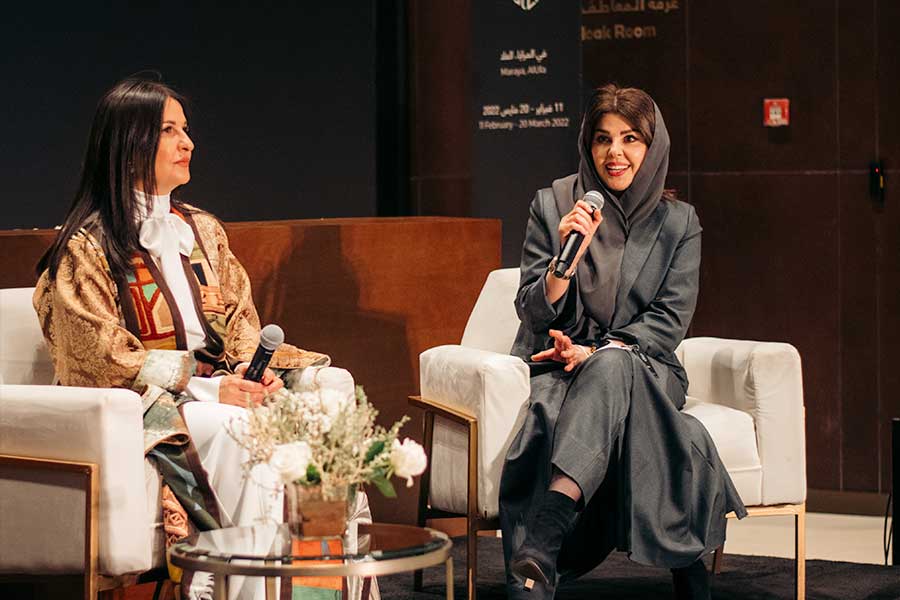
Basma AlSulaiman and Lulwah AlHomoud in conversation at the What Lies Within launch in February 2022
CREDITS FOR OPENING VIDEO:
1) Mystic in White (Shadows), 2008-2009. Hussein Al Mohasen (photo Zaki Ghawas)
2) Food for Thought “Al Muallaqat 5”, 2017, Maha Mullah (photo Zaki Ghawas)
3) Holy-Wood, 2014. Musaed Al Hulis (photo Zaki Ghawas)
4) Magnetism 2009, Ahmed Mater (photo by Christie’s)
5) The Choice, 2005, Manal Al Dowayan
6) Brand 2, 2019, Rashed Al Shashai (photo by Mohammed Al Shebli)
7) From Here We Started, 2018, Zahrah Al Ghamdi (photo Mohammed Al Shebli)
8) The Black Arch, 2021, Shadia Alem (photo Andrea Avezzu)
9) Scrolls of The Prophets II, 2015, Dana Awartani (photo Zaki Ghawas)
10) Concrete Wall, 2010. Abdulnasser Gharem (photo Zaki Ghawas)
11) The Opening, 2010. and Ameen, 2011. Ayman Yossri Daydban (photo Zaki Ghawas)
Artworks and installation views of What Lies Within AlUla 2022, reproduced here with kind permission of the artist and the Basma Al Sulaiman collection
